Click to enlarge
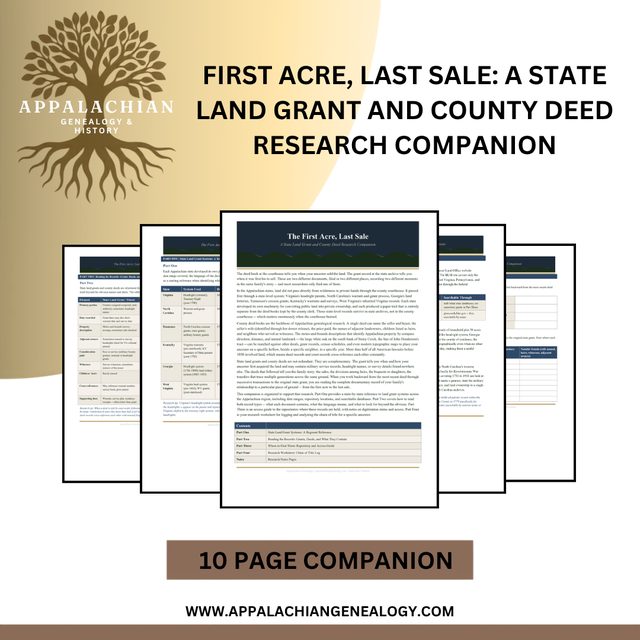
10 page PDF research guide includes:
Guide for The First Acre: How State Land Grants and County Deeds Together Tell the Story No Single Record Can
The deed book at the county courthouse tells you when your ancestor sold the land. The grant record at the state archive tells you when it was first his to sell. Most researchers find one of these documents and never look for the other, which means they are reading half the story at best. In Appalachia, land did not pass from wilderness to private hands through the county courthouse. It passed first through a state-level system: Virginia's headright patents, North Carolina's warrant-and-grant process, Georgia's land lotteries, Tennessee's cession grants. Each state produced a paper trail that survives in a completely separate place from the county deed books. When the courthouse burned, those state records often did not. When a deed chain goes cold, the grant record may be exactly where the family's story picks up again.
What's Inside
- State-by-state land grant reference table covering Virginia, North Carolina, Tennessee, Kentucky, Georgia, and West Virginia, with system type, date range, key documents, and primary repository for each
- Critical distinction table separating state land states from federal public land states, with a direct note on why the BLM General Land Office site returns no results for Appalachian ancestors
- Element-by-element comparison of state land grants and county deeds, covering primary parties, property description, adjacent owners, consideration, witnesses, heirs, and cross-references
- Reading guide to metes-and-bounds descriptions, witness patterns, the chain of title, and the dower release as a tool for recovering a wife's name
- Repository and access guide with URLs, digitization status, and research notes for every state in the table
- Chain of title log for recording successive transactions from most recent deed back to original state grant
- State land grant analysis block and county deed analysis block for documenting a specific ancestor's land record in full
- Notes pages