Click to enlarge
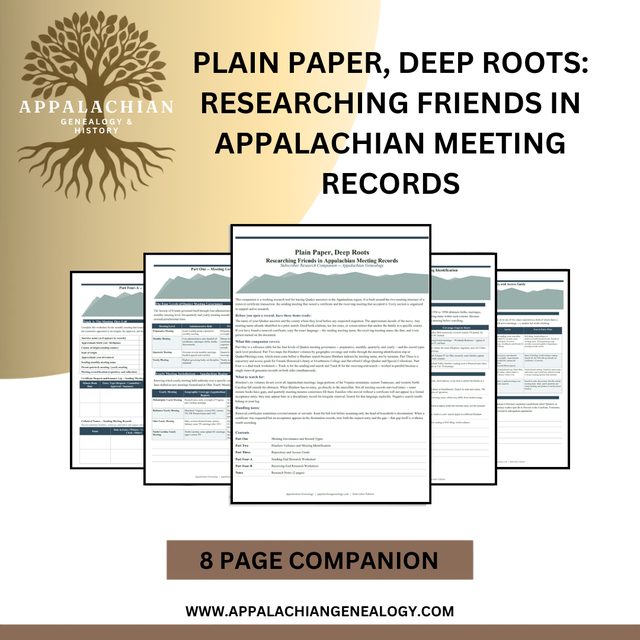
8 page PDF research guide includes:
Guide for The Plain Paper Trail: Finding Quaker Ancestors in the Appalachian Mountains
Quaker families who moved across the Appalachian Mountains left a paper trail in two sets of records at once: the minute books of the meeting they left and the minute books of the meeting that received them. Knowing how to read both ends of that transaction is what turns a removal certificate from a single data point into a gateway for family research. A family who moved without a certificate will not appear in a formal acceptance entry; they may surface later in a disciplinary record for irregular removal, and this companion tells you to look for that language explicitly.
What's Inside
- Meeting governance reference table covering preparative, monthly, quarterly, and yearly meeting levels with primary records generated and genealogical value for each
- Yearly meeting jurisdiction table covering Philadelphia, Baltimore, Ohio, and North Carolina Yearly Meetings with geographic coverage, key dates, and Appalachian research notes
- Hinshaw volume coverage guide identifying which states and key Appalachian meetings each of the six volumes covers, with coverage gaps noted
- Six-step meeting identification sequence using QuakerMeetings.com before opening a Hinshaw volume
- Repository and access guide covering Friends Historical Library at Swarthmore, Haverford College Quaker and Special Collections, FamilySearch microfilm, QuakerMeetings.com, and Appalachian State University Special Collections
- Sending-end research worksheet tracking certificate request, committee appointment, approval, and issuance in the sending meeting's minute books
- Receiving-end research worksheet tracking certificate acceptance, family members named, collateral names, and post-arrival records
- Notes pages
Paid Subscribers Only
Get Your Copy