Click to enlarge
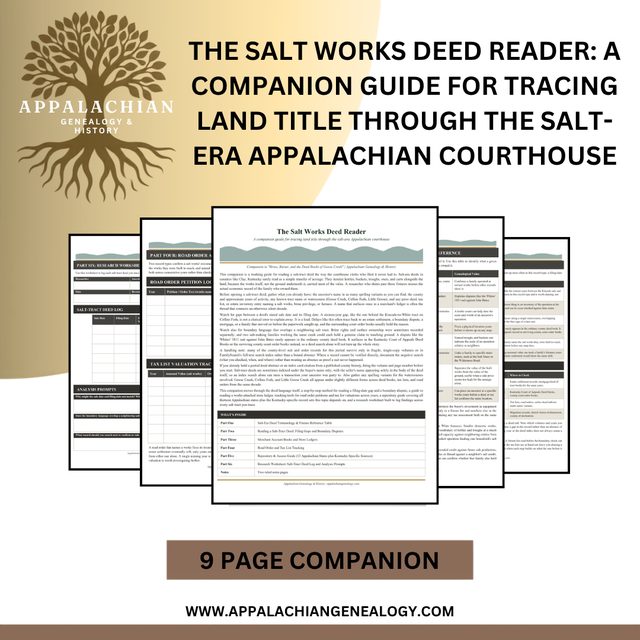
9 page PDF research guide includes:
Guide for Brine, Barter, and the Deed Books of Goose Creek
A salt-tract deed almost never tells the whole story on its own. The kettles, troughs, and named oxen that carried real value scatter across fixture lists, tax assessments, and estate inventories. A boundary dispute surfaces only in an appeals-court file most researchers never think to check, and a family's actual presence at a works often survives only in a merchant's running ledger. This companion moves through all of it: the deed language itself, a step-by-step method for reading a filing-date gap and a boundary dispute, tools for tracking road orders and tax valuations across years, and a repository guide built around the Kentucky Court of Appeals Deed Books.
What's Inside
- Salt-era deed terminology reference table covering eight terms and fixtures, from brine privilege to named oxen and carts, with where each appears elsewhere in the record and its genealogical value
- Six-step method for reading a salt-tract deed, built around catching a filing-date gap and a boundary overlap
- Signal table interpreting four causes behind a filing-date gap and where to check each one
- Merchant account book and store ledger reference table covering seven entry types and what each reveals about a household's presence at a works
- Road order petition log and tax list valuation tracker for confirming a works' location and following its assessed value across years
- Kentucky-specific source guide covering the Secretary of State Land Office, the Court of Appeals Deed Books, and the Clay County Genealogical & Historical Society
- Thirteen-state repository and access guide, plus the Library of Congress
- Research worksheet with an ancestor identification block, a salt-tract deed log, and three analysis prompts
- Two ruled notes pages