Click to enlarge
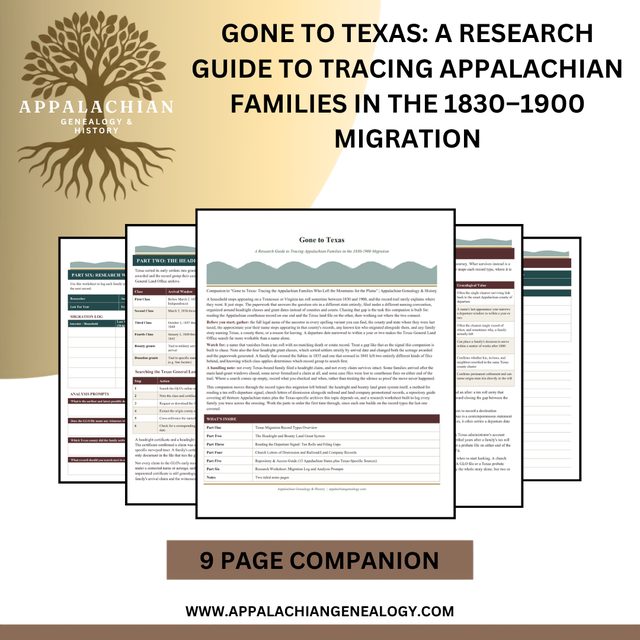
9 page PDF research guide includes:
Guide for Gone to Texas: Tracing the Appalachian Families Who Left the Mountains for the Plains
A name stops showing up on a Tennessee or Virginia tax roll sometime after 1830. The county record never says why. The answer usually sits hundreds of miles away, filed under a headright class instead of a courthouse docket, where a Texas land file names the same household through a witness's sworn statement instead of a tax assessor's ledger entry. This companion moves through the four grant classes that sorted every arriving settler by date, a method for reading a tax roll's silence as a departure signal, the church letters and land company circulars that can date a family's intent before the gap ever opens, and a repository guide built around both ends of the crossing.
What's Inside
- Migration record types overview table covering GLO headright and bounty files, county tax rolls, church letters of dismission, railroad and land company promotional records, federal census records, and Texas probate and estate records, with where each is held and its genealogical value
- Headright and bounty land grant class table covering all four settler classes plus bounty and donation grants, with arrival windows, acreage, and requirements, plus a six-step method for searching the Texas General Land Office archive
- Departure signal reading method with a six-step tax roll analysis process and a four-signal interpretation table
- Church letters of dismission reference table for Baptist, Methodist, and Presbyterian records, plus a railroad and land company promotional records table
- Repository and access guide covering four Texas-specific archives, the standard thirteen-Appalachian-state guide, and the Library of Congress
- Research worksheet with an ancestor identification block, a migration log, and four analysis prompts
- Two ruled notes pages