Click to enlarge
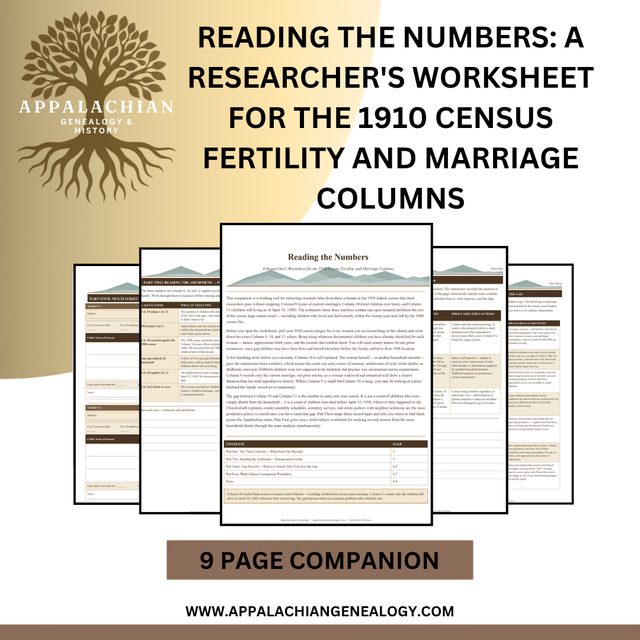
9 page PDF research guide includes:
Guide for The 1910 Census “Miracle” Columns: How Two Numbers Reconstruct Lost Appalachian Families
Three columns near the center of the 1910 census page get skipped more often than any other part of the schedule, wedged as they are between marital status and nativity. But for any woman who lived through the years the 1890 census schedules burned, those columns hold the only surviving count of every child she ever bore. This companion moves through the arithmetic those numbers support: how to size the gap between children born and children living, how to flag a first husband the family record never mentioned, and how to carry that gap count into the record types most likely to name a child who otherwise left no trace.
What's Inside
- Three-column reference table covering Columns 9, 10, and 11, with what each records, the calculation it supports, what it proves, and edge cases and cautions
- Six-calculation arithmetic interpretation guide for reading gap counts, flagging prior marriages, cross-referencing against the 1900 census, and running age-gap analysis within a household
- Gap Records reference table covering seven record types, church death registers, county mortality schedules, cemetery surveys, estate packets, neighbor testimony, civil death registration, and newspaper death notices, with what to look for, where to find it, and Appalachian access notes
- Multi-subject comparison worksheet for tracking up to four women from the same household cluster through the identical analysis, each with an ID block, a child-by-child log, and a gap-count summary
- Two ruled notes pages, the first with a research log table