Click to enlarge
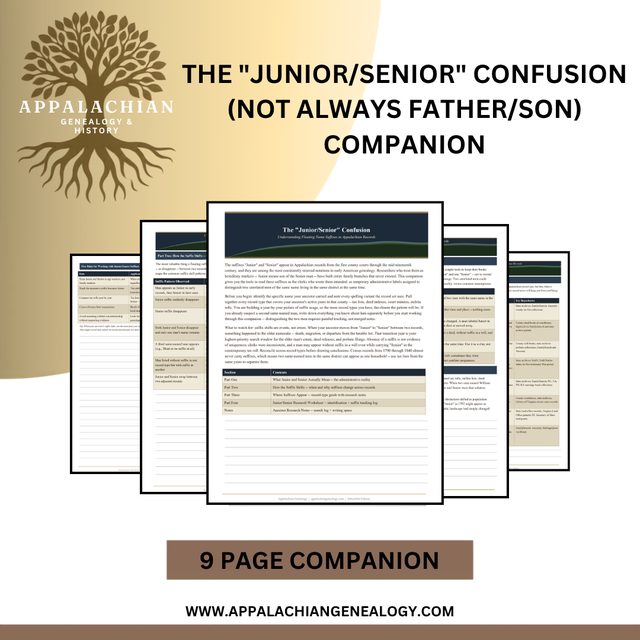
9 page PDF research guide includes:
Guide for The “Junior/Senior” Confusion (Not Always Father/Son)
When a clerk in an eighteenth-century Appalachian county court wrote "Junior" next to a man's name, he was solving an administrative problem. Two men shared the same name in the same district, and the record needed to tell them apart. The suffix had nothing to do with family relationship. The younger man was Junior and the older was Senior, whether they were father and son, cousins, or complete strangers, and when the older man died or moved away the clerk reassigned the labels to whoever remained. A man who appears as Junior in a 1792 tax list may appear as Senior in a 1797 deed, and researchers who treat that shift as an error rather than a signal miss the most useful thing a floating suffix can tell them: that something happened to the other man, and that the transition year is a search window worth working. This companion gives you the framework for reading suffix usage correctly across tax lists, deeds, wills, militia rolls, and court minutes, and the tools for separating two same-named men whose records have been collapsed into one.
What's Inside
- Administrative reality reference table contrasting common assumptions about Junior and Senior with how clerks actually assigned and reassigned those labels
- Suffix shift pattern guide covering seven transition patterns with what each one likely signals and which record types to search next
- Five rules for working with Junior and Senior suffixes in Appalachian research
- Record-type guide covering tax lists, deed records, wills and estate records, militia and muster rolls, marriage bonds, and church records, with how suffixes appear in each and what inconsistencies are normal
- Case study tracing a documented Washington County, Virginia suffix shift from identification through resolution
- Ancestor identification and suffix tracking log
- Distinguishing evidence log for recording land descriptions, neighbor names, witness names, and ages that separate two same-named men
- Notes pages