Click to enlarge
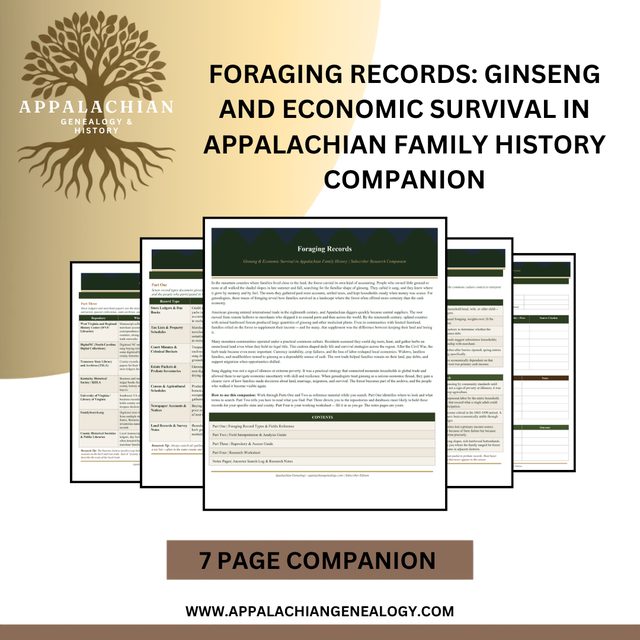
7 page PDF research guide includes:
Guide for Foraging Records: Ginseng and Economic Survival in Appalachian Family History
Sang paid the store account when the crop failed and settled the tax bill when cash was short, and the families who dug it were participating in a trade that connected remote mountain hollows to markets in China and Europe. That labor left a paper trail most genealogists have never followed. The store ledger that recorded twelve pounds of sang against a family's account names the digger, the price, and the merchant, and that same merchant's probate file may hold notes owed by dozens of families in the same community. When timber companies began enclosing formerly common forest land after the Civil War, the disputes that followed went into court trespass dockets that place specific families on specific tracts. Survey calls name sang licks and herb grounds that survive as place names on maps still in use today. This companion walks you through where those records are, what they contain, and how to read what you find.
What's Inside
- Seven-type foraging records reference table covering store ledgers and day books, tax lists and property schedules, court minutes and criminal dockets, estate packets and probate inventories, census and agricultural schedules, newspaper accounts and notices, and land records and survey notes, with what to search for, variant spellings and terms, and research value for each
- Field interpretation guide covering the anatomy of a store ledger foraging entry and five interpretive frameworks for commons culture and customary rights, women's and children's labor, post-Civil War economic disruption, migration decisions and forest access, and geographic specificity
- Repository and access guide for the West Virginia and Regional History Center, DigitalNC, Tennessee State Library and Archives, Kentucky Historical Society and KDLA, University of Virginia and Library of Virginia, FamilySearch, and county historical societies, with search strategies for each
- Foraging records found log
- Household members identification log
- Cross-reference and follow-up log
- Notes pages